Showing posts with label Chickens. Show all posts

Saturday, March 21, 2015

Identifying Roosters in Young Chicks

 
If you have never owned a rooster before, it can be difficult seeing the signs of one in your own  young flock. When I first started raising chickens, I was often fooled a lot. I still end up with a few males here and there, but I have gotten a lot better at identifying them before even buying them now. 

If you are buying chicks that are vent sexed, their is still a 5%-10% chance of getting a male. I honestly don't know if I believe that, unless of course I just happen to have the worst.luck.ever! I always seem to get a pretty decent male to female ratio. I don't mind a few select roosters, but I don't need them to outnumber the hens. Heck, I don't even want a quarter of them to be roosters, but it's a gamble.

It really is..

The only guaranteed way you are getting female chicks is by purchasing Sex Links. They come in several varieties, and just basically signifies that you can auto sex them at birth depending on their coloration.

I recommend Sex Links for someone looking for a hardy breed that will lay consistently without having to chance winding up with a male. I chose 6 Black Sex Links and 4 Golden Sex Links to start off with. They make a perfect beginner "breed", and are pretty common, and easy to find.


Signs to look for:

Thick Legs and Large Feet- This is a pretty good indicator if you have several of the same breed and age to use for comparison. You can hold a chick in each hand and compare with little effort. Males legs and feet tend to be thicker, longer, and more defined. Keep in mind that some breeds tend to have bigger legs in general, and even some pullets can look more masculine than their male counterparts, so it's certainly not definitive. Make sure to check for all the signs listed below, as the more you notice, the more likely the chick in question is indeed a male.

Body Size- When looking at chicks the same age and breed you can easily pick out some of the larger birds. Males tend to be larger early, on making it a decent indicator for selecting the sex you want. I have also noticed that males will have larger heads than the females, even before their body size gives them away.

Comb and Wattle Development- From very early on you should be able to spot more pronounced combs amongst chicks of the same age. Within a couple weeks, the cockerels combs start getting noticeably redder than the other chicks. The wattles will start presenting themselves, and the more red and defined they are, the more likely it is you've got yourself a male. Remember; pullets will also start developing wattles and combs in certain breeds, but it is pretty easy to differentiate from the males as they will be smaller and lighter. As they get older, pullets combs tend to be flop over, while the cockerels will stand up.

Feather Development- Despite their larger stature, young male chicks tend to feather out at a slower rate (sometimes a lot slower) keeping their down for a bit longer as the females start showing their true colors and patterns. Females will also start developing more prominent wings and tails before the males do. In some breeds, feather coloration can even be an immediate giveaway as to if the chick is male or female. In this case, they are called Sex Links. As they age, pullets will start developing their straight, rounded tail feathers (all feathers on tail will be round if female) while their male counterparts start developing what we call "Hackle Feathers", "Saddle Feathers" and "Sickle Feathers" (see below) Males will also start growing in some pretty green iridescent plumage, generally around the neck and tail. These things will happen as the cockerel starts nearing maturity, around 5-6 months of age.

Early signs of male vs female feather development:


The same cockerel, Lindsay Cluckingham, as a rooster and Miss Gypsy (still a non laying pullet) at 5 months old:


They are both Easter Eggers. Notice the male (on top) has a larger, darker comb, and long, pointed hackle feathers.


Hackle Feathers- This is the term referring to the feathers around the neck of the chicken. The will be rounded like a spoon and shorter on females while the opposite holds true for the males, being long and pointed. These are the feathers roosters puff out when getting into a scuffle with another male.

Saddle Feathers- These are the feathers found towards your chickens bum. On males they will start to look longer and flowing, cascading down their back end. Pullets will have rounded saddled feathers.

Sickle Feathers- These are the long, curved feathers on the tail. This signifies a rooster.


Now these tricks may not be as fail safe as sexing based upon appearance, but when I spend a lot of time with the chicks I begin to be able to spot the males out of the group. Males will tend to be less shy at first than the females. At a very early age I have noticed the males seeming to stand watch over the rest of the group. They also seem to make more eye contact, be a bit noisier, stand up straighter as if they have a lot of pride (which they should!!) and sometimes even a little more aggressive about things like eating, getting the best spot to roost, etc. Cockerels usually start making little clicking and chirping sounds before they start crowing, and seem to cause a lot more fuss about things than the ladies do.


Sunday, March 15, 2015

Definitely NOT a hen..


Today was like any other day. I woke up, took the dogs out, gave the ducklings a swim, and proceeded to care for the chickens. It has been raining like CRAZY here, and being near Houston during a downpour equates to a lot of flooding. We actually had a flash flood warning! Despite the weather app on my ipad saying this week would be full of dry, sunny skies, the clouds had to have it their way.

We are in the process of building up our property, and have to start off with the chicken coop and yard area. Our poor hens are SO mad at me. They will venture out of the comfort of their coop to forage for awhile before putting themselves in early. So with the chicken yard empty, I decided to let the teenagers (5 month olds) out in the Big Girl Pen for awhile. They have a separate pen that's attached to the larger one so that the hens will get used to them before we combine the flock. 

As I was taking them one at a time to the big girl pen, I heard a rooster crow! It was too loud to belong to a neighboring farmstead, so I went to check it out. It was Dawkins!! My Barred Easter Egger. He is gorgeous, and finally became a man (or should I say Rooster) today! Yay!! Enjoy some photos of him and our other Easter Eggers. Out of the 5 I bought from an add on Craigslist, 3 of them are males. Bummer!


 ^My favorite little pair of Easter Eggers: Stevie Chicks and Lindsay Cluckingham <3

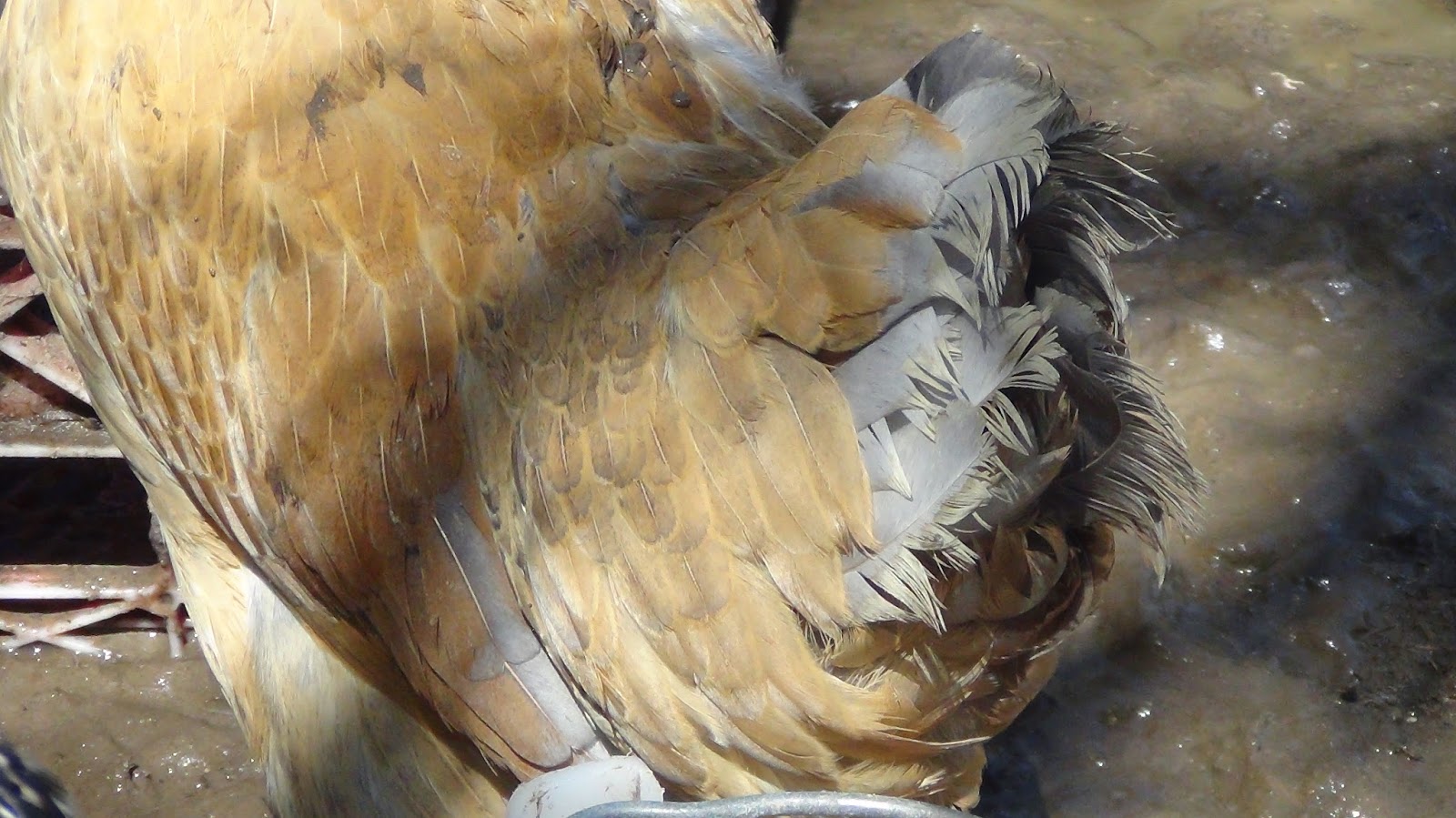
Miss Stevie's fluffy butt finally feathering out!


 Lindsay giving the stink eye to his arch nemesis. 


Thursday, March 12, 2015

Breed Breakdown: Black Sex Links


Brief introduction
First off, Black Sex Links are not considered a breed. Why? Since Black Sex Links are a hybrid of two different heritage breeds (most commonly a Rhode Island Red roo crossed with a Barred Rock hen), they are considered a crossbreed.

Breeding:
To get a Black Sex Link, you would breed a red variety rooster such as New Hampshire Red or Rhode Island Red to a Barred Plymouth Rock hen. This results in chicks whose sex is distinguishable at birth. Males from this cross will feather out with the pattern of the Barred Rock with random red feathers while the females feather out to a deep black with a green sheen, especially towards the tail feathers accompanied with golden laced hackle feathers. Upon hatching, sex is determinable. Pullets are all black while cockerels are black with a white spot on the top of their head.

While being large birds perfect for meat production and being prolific layers of large brown eggs, their genetics do not pass true. Unfortunately, since the Black Sex Link is not a breed, the genes are not heavily imprinted enough to guarantee offspring of equal value. Any offspring produced by sex links are doubtful to produce as many eggs, and therefor do not make the best type of chicken to breed if you're looking to produce more egg layers.

Pros:
Excellent egg producer of large medium toned brown eggs
Perfect dual purpose bird- meat birds, egg layers, and pets.
Hardy bird, tolerant to both hot and cold weather.
Doesn't go broody often (which is great since you may not want to breed this bird)
Perfect to hatch/buy if you're looking for a 100% accurately sexed chick.

Cons:
Very vocal.
Bossy, doesn't take to new flock members easily.
Overconfident, can lead to easy targeting of predators.


My First Hens- A throwback

Picture it:
February 2014
Cold. Wet. Muddy.
Still settling into a new place.

I con my sweet boyfriend into taking me to the local feed store, only a mere 5 miles away. Little does he know, it's chick season. I know what I am up to. He hasn't the foggiest. He is just happy to go along and check out the store I visited regularly as a child.

Before we walk in, I see the galvanized tubs and heat lamps.
We're in business!

I take a look at the cute baby turkeys and adorable little ducklings, and proceed with caution towards the next set of brooders. I peek inside, and up at me looks a hundred or so little black chicks peeping like mad. I give them all a once over, picking up the ones that caught my eye. 

That cold day in February, 6 little Black Sex Link Pullets came to live in my shower. I was not prepared, but I was thrilled!

Like all new, on a whim, chicken owners, I needed more supplies than I managed to get the first day I picked up the chicks. We went back the very next day, and they lady who hatched the first batch of chicks we bought was replenishing the brooder with some new faces. Cute, yellow fluffy faces..

Without a second thought, I scooped up four of those cuties and headed towards the check out. Golden Sex Links this time. Oops. I got sidetracked! "A bale of hay and another waterer please!" And we were on our way home to add our new chicks to our previous purchase for a grand total of 10 sweet babies! 


The chicks quickly grew out of their plastic tub, and were soon placed in my shower in a cardboard brooder. I was pretty proud of that thing! I started off with a normal heat lamp and realized it caused my chicks to peck at each other more, and seemed to keep them up at night. Which in turn kept me up at night.. So we switched to a red light. My bathroom quickly became known as the Red Light District, housing 10 of the hottest chicks I've had the pleasure of getting to know! ;)

It wasn't too long before the chicks were causing such a mess with their feathers and such that they needed a nice, new, OUTDOOR place to call home. My awesome boyfriend set out to build me coop! 

Months went by, just me and my girls getting to know each other, learning and growing. Figuring out this homestead life. Then one day I heard one of them making an awful noise that sent me running to check on them. I thought she was being attacked or may have been in injured, but nope. One of my girls laid her first egg! OUR FIRST EGG!! I was SO friggin proud :)


Ophelia still lays this gorgeous white specked, light brown egg. It is just a lot larger now! Their eggs don't sit in a normal egg carton. I love my girls! With ten of them, they produce enough eggs to sell some, paying for their feed. 

Last fall. After several months of laying. Big Brown Eggs!


My first year as a chicken keeper has been crazy! It has had its ups and I would say downs, but I've been pretty lucky so far! Everyone is fat and healthy. We are always working on expanding their run, and they will soon have more yard space than I do! They used to be allowed supervised free range, but sadly the owls, hawks, falcons, and even crows have set up camp, building nests and having babies. Hungry babies that need to be fed.. :(

The 6 chicks I bought on a whim quickly turned to 10, then 15, to 20, to 26! I am officially a crazy chicken lady. And if your haven't heard, chickens are a gateway animal! I now have 2 adorable ducklings, and am drooling over quail and geese..


Do you have any chickens of your own?


Sunday, March 8, 2015

My First Buff Orpingtons

One Day Old Buff Orpington Chick

Isn't she (fingers crossed!) absolutely adorable?! 

I have been dreaming of owning a Buff Orpington of my own for almost a year now. Since the purchase of my first chicks, I longed for a little yellow fluffy butt to add to my flock. Not that my first girls aren't beauties, I just happen to love the way Orpingtons are shaped. They look so fat and happy it makes my heart flutter. Yes, I am aware of how crazy I sound. I have already came to terms with being the Crazy Chicken Lady. It's OK! I like it that way. Better than being a crazy cat lady any day.

My local feed store informed me via Facebook that they just got in a batch of female Buff Orpingtons and New Hampshire Reds. With a little bribery, I was given the okay, and we were on our way to get 2 new babies. After seeing how cute they all were, we left with a total of 5!! 3 Buff Orps and 2 New Hampshires. They have been settled in for a couple days now, and I am already in love. It is a bit hard to tell them apart, aside from Lucy, the red New Hampshire chick. The others are all adorably yellow! :| I am hoping once they mature and develop their own personalities I will be able to tell them apart.

Check back to see them grow! I have been photographing them daily. I swear they have already doubled in size!